

Case study · Nidec Drives
An AI briefing that gave Nidec's leadership one shared view.
A leadership session for Nidec Drives, a global leader in motor control and drives, that set out where AI creates real value in industrial manufacturing and how to adopt it within the governance Nidec already has.

Delivered by Enceladus AI, the PureNet Group’s AI consultancy.
The challenge
Nidec Drives designs and makes motor control and drive technology used in demanding industrial settings around the world. With manufacturers and automation firms adopting AI quickly, Nidec wanted its senior team to stop experimenting in isolation and agree where AI could safely add value, both in how the business runs and in the products it sells.
The question was no longer whether to use AI. The leadership team wanted to know:
- Which opportunities would bring real commercial and operational return
- How to tell AI that can be deployed today from the hype
- How competitors such as Siemens, ABB and Schneider Electric are building AI in at scale
- How to adopt it within regulatory, ethical and governance limits
- How it would fit the evaluation frameworks and data Nidec already has
What they needed was a common, grounded picture of AI in an industrial business, not a general technology pitch.
The project
Enceladus AI ran a senior leadership briefing on AI awareness and strategy, built around industrial manufacturing and drives. It deliberately left tools and demonstrations aside, and instead:
- Raised AI understanding at board and leadership level
- Explained why 2025–26 is a turning point for AI
- Put complex ideas into terms engineers already use
- Tied every opportunity to Nidec’s own governance
The session covered five areas.
Why now. The move from AI pilots to AI in production is being driven by transformer models, the scale of GPU computing, internet-scale training data and investment that is sustained rather than cyclical. AI is a step change in capability, not a passing trend.
What competitors are doing. Industrial peers already use co-pilots for engineers, predictive maintenance, automated quality inspection, intelligence built into products, and agents working across supply chains and operations. AI is today’s competitive baseline, not a future plan.
More than generative AI. Generative AI sits alongside classical machine learning, computer vision, reinforcement learning, optimisation and digital twins. In manufacturing, several of these return value faster than generative AI alone.
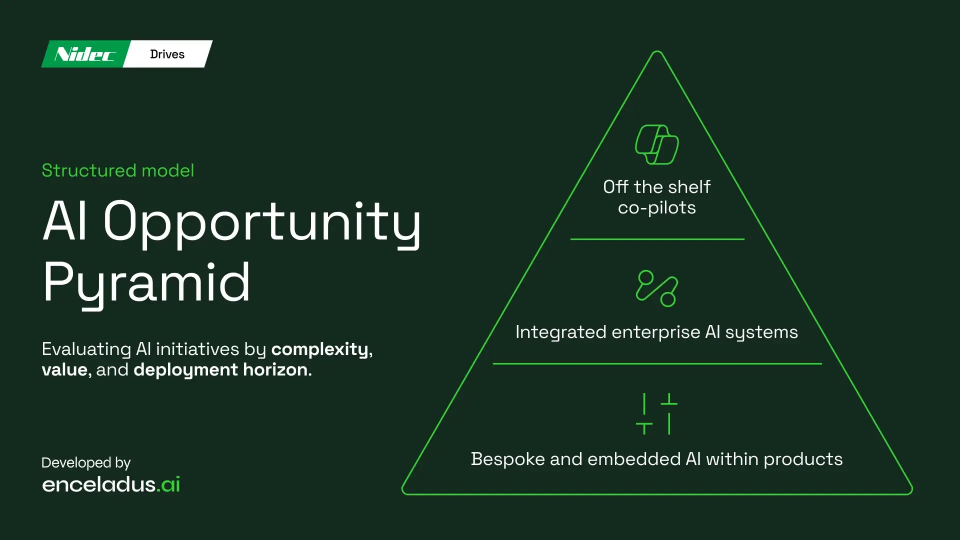
The AI Opportunity Pyramid. A way to weigh each idea by complexity, value and how soon it can be deployed, from off-the-shelf co-pilots, through integrated enterprise systems, to bespoke AI built into products. It gave the team a realistic basis for setting priorities.
Governance, ethics and regulation. Each opportunity was set against the EU AI Act’s risk-based approach, the principles of responsible AI (fairness, transparency, accountability, privacy and safety) and Nidec’s own working groups and evaluation templates. The finding: Nidec’s governance already fits AI well, so it can adopt AI without redesigning how it makes decisions.
The results
The leadership team left with one vocabulary for modern AI, a clear view of where it already delivers value in industry, a sense of which opportunities are near-term and which are longer bets, and confidence that adoption can go ahead within existing governance.
The session successfully shifted the conversation from “Should we use AI?” to “Where will AI create the most value — and what is the right approach for each opportunity?”
The next step was to take the conversation beyond the leadership team, through facilitated workshops across engineering, operations and commercial teams, business cases built on Nidec’s own evaluation framework, and a mix of quick wins and longer-term product opportunities. That work is told in From 250 ideas to 27 use cases.