
AI · 5 min read
The EU AI Act in 2026: what UK businesses need to know.
What the EU AI Act means in 2026 for UK businesses that sell into the EU or use AI in their ecommerce, portals and back office, including the new high-risk dates.
If you’re a UK business, it’s tempting to think the EU AI Act isn’t your problem. Britain doesn’t have an AI statute of its own, and the Act is European law. But if you sell into the EU, or the people using what your AI produces are in the EU, parts of it may well apply to you.
2026 is also the year the Act’s dates moved. Here’s where things stand in November 2026, in plain English. It’s general information to help you ask the right questions, not legal advice: for your own situation, talk to a lawyer.
What is the EU AI Act?
The EU AI Act (Regulation (EU) 2024/1689) is the first broad law on artificial intelligence. It came into force on 1 August 2024 and applies in stages. Rather than regulating the technology itself, it regulates uses of AI by how much harm they could do, and it splits the duties between the business that provides an AI system (builds it or puts its name on it) and the business that deploys it (uses it in its work).
Does the EU AI Act apply to UK businesses?
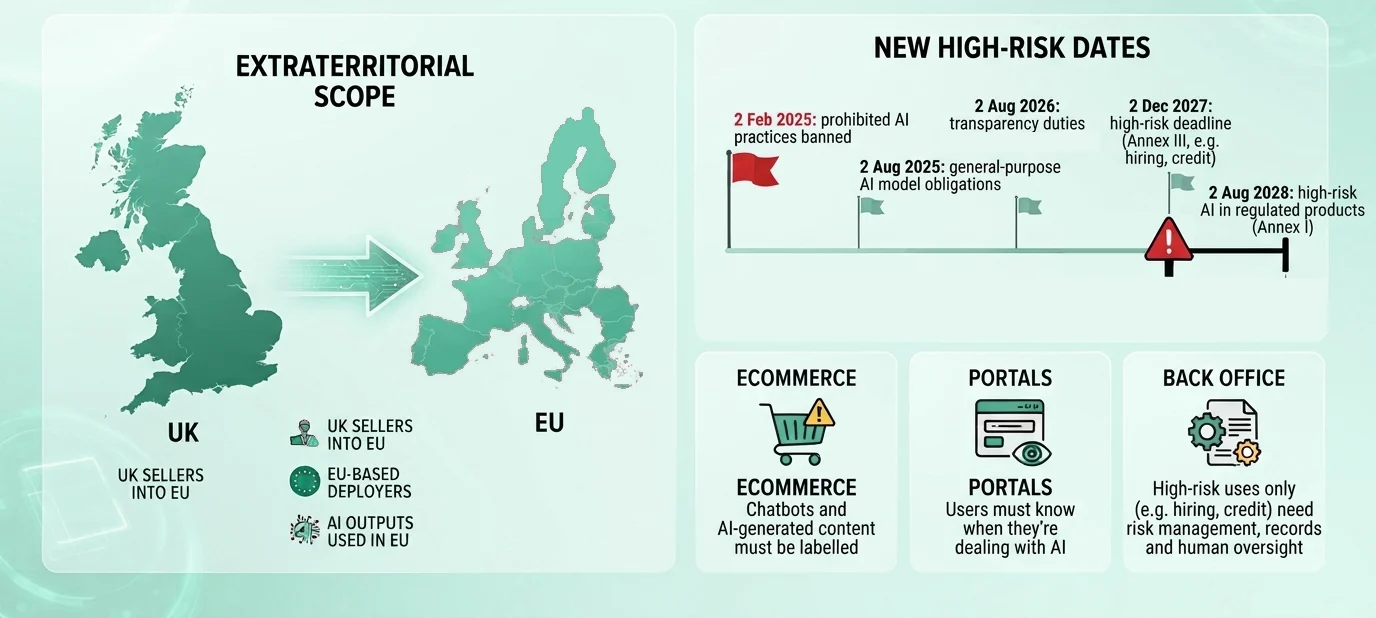
It can. The Act reaches beyond the EU’s borders in two main ways:
- You provide AI in the EU. If you place an AI system on the EU market, or put it into service there, the provider duties apply wherever you’re based.
- Your AI’s output is used in the EU. If you’re a provider or a deployer outside the EU, and what your AI system produces is used in the EU, the Act can apply too.
So a UK manufacturer with an AI shopping assistant on its EU storefront, or a wholesaler whose AI agent quotes prices to customers in Ireland, should check where it stands. A business that only uses AI internally in the UK, for UK customers, is far less likely to be caught.
In the UK itself, AI is regulated through existing law and regulators instead: UK GDPR, consumer, equality and employment law, with the ICO’s guidance on AI and data protection the closest thing to a rulebook.
What are the AI Act’s risk tiers?
The Act sorts uses of AI into four tiers. In plain English:
- Banned. A short list of practices that aren’t allowed at all, such as manipulating people in harmful ways, social scoring, and (added in 2026) AI that generates non-consensual intimate images or child sexual abuse material.
- High risk. Uses where a wrong answer can seriously affect someone’s life or safety: for example AI in recruitment and managing staff, in education, in access to essential services, in assessing an individual’s creditworthiness, and AI inside regulated products such as machinery and medical devices. These carry the heaviest duties: risk management, data governance, logging, human oversight, accuracy and documentation.
- Limited risk, with transparency duties. People must be told when they’re talking to an AI, such as a chatbot, and AI-generated content must be marked so it can be recognised.
- Minimal risk. Everything else, which is most AI in business, from spam filters to product recommendations. No new duties, though good practice still applies.
For most ecommerce and portal uses, such as AI search, product recommendations, dynamic pricing and generated product content, the answer is usually minimal or limited risk. The exceptions to watch are AI used on people: screening job applicants, managing staff, or deciding whether an individual gets credit.
What changed in 2026?
The original timetable was:
- 2 February 2025: the bans, and a duty on AI literacy, applied.
- 2 August 2025: duties for providers of general-purpose AI models (the large models behind tools such as ChatGPT and Claude) applied.
- 2 August 2026: most of the rest, including the transparency duties and the high-risk duties for most systems.
- 2 August 2027: high-risk AI inside regulated products.
In 2026 the EU changed that. The Digital Omnibus on AI, Regulation (EU) 2026/1744, was adopted on 8 July 2026 and came into force on 27 July 2026. Its main effects:
- High-risk duties for most systems moved to 2 December 2027 (from 2 August 2026).
- High-risk AI in regulated products moved to 2 August 2028 (from 2 August 2027).
- The transparency duties still applied from 2 August 2026. Generative AI systems already on the market before then have until 2 December 2026 to mark their output.
- New bans were added, on AI that generates non-consensual intimate images or child sexual abuse material.
- The AI literacy duty was softened. Businesses still need to make sure the people using AI understand it, but there’s no longer a requirement to guarantee any specific level of literacy.
So the EU AI Act in 2026 is less of a cliff edge than many expected. The bans, the general-purpose AI rules and the transparency duties apply now; the heaviest duties arrive at the end of 2027.
What should a UK business do now?
Whether or not the Act applies to you, the same handful of steps will put you in a good position, and they’re simply good AI governance:
- Name an owner. One person, not a committee, who owns your AI policy and reports to the board.
- Write a short AI policy. One page that says which tools are approved and what may and may not go into them, with a traffic-light list: green, go ahead; amber, with a condition; red, not with these tools.
- Take an inventory. Every AI tool and system in use, who owns it, what data it touches, and whether any of it reaches customers or people in the EU.
- Give each use a risk tier. Most will be low. Flag anything that touches recruitment, staff, credit or safety, and anything customer-facing that should tell people they’re talking to an AI.
- Put oversight where it matters. For anything higher risk, a person with the authority, understanding and time to say no, and a record of what the system did.
- Check your suppliers. Who is the provider of each AI system you use, and what do their terms say about your data and their obligations?
If you want a recognised framework to work to, ISO/IEC 42001 is the certifiable standard for managing AI, and a business that already holds ISO 27001 has much of what it asks for. Some organisations also use the US NIST AI Risk Management Framework, which is voluntary but useful for structuring AI risk.
Where PureNet can help
We build AI into ecommerce stores, customer portals and back-office systems, and we govern everything we build: tested on every change, logged, overseen by a person and fitted with an off switch, under our ISO 27001 controls.
- AI governance: your owner, AI policy, inventory and risk tiers, put in place with you.
- AI consultancy: where AI will pay in your business, sequenced by readiness, with governance built in from the start.
- Not sure where to begin? Our free AI Readiness Audit looks at where AI is already in use in your business and where your opportunities are, or take the three-minute AI readiness score first.
The EU AI Act will keep evolving, and the dates above may move again. We’ll update this post as they do.